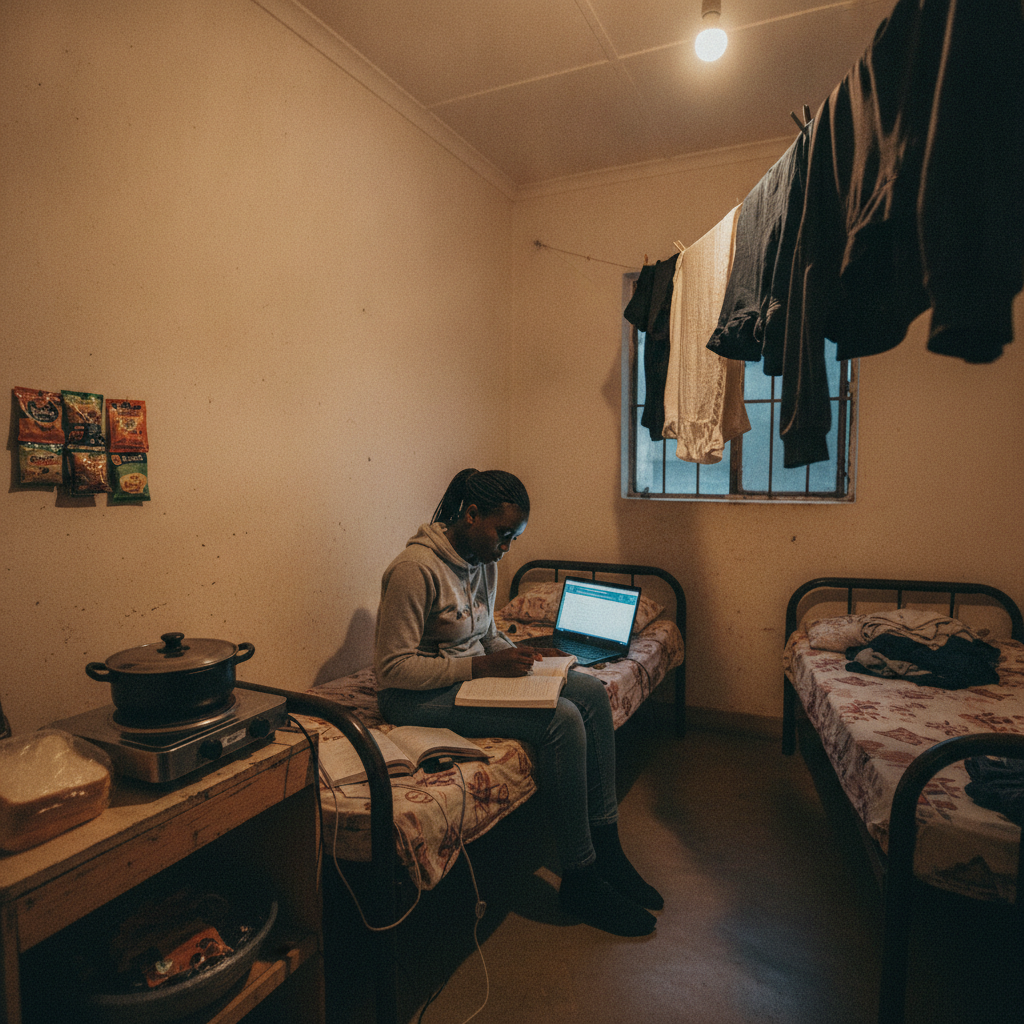
8pm, a hostel room near Kenyatta University
Wanjiku balances a sufuria of ugali on a single-burner hot plate she is not supposed to have. The university banned hostel cooking two years ago, but the cafeteria closed at seven and she cannot afford to eat out. Her roommate is studying on the top bunk with earphones in. The room smells like maize flour and kerosene from the neighbor's stove. This is dinner: ugali and sukuma wiki. It cost her KES 45 in ingredients. It is the same meal she cooked yesterday, and the day before that.
Her HELB upkeep loan deposits KES 5,000 a month into her M-Pesa. Rent takes KES 3,000. Transport takes another 800. What remains -- roughly KES 1,200 -- must cover food, learning materials, and everything else for the month. She eats twice a day. Breakfast is chai and mandazi from the vendor near the gate, KES 40. Dinner is whatever she can cook on this illegal hot plate. On a good week, she buys an egg or two. On a bad week, she borrows ugali flour from a friend down the hall. 60.7% of students at her university eat fewer than three meals a day. Over 40% skip breakfast entirely. She is not unusual. She is average.
Wanjiku knows, in the way everyone knows, that she should eat more vegetables and less starch. But a kilogram of kale costs KES 114 -- nearly three days of her food budget. An egg is KES 21. A mango is KES 30. The cheapest meal that fills her stomach is ugali and sukuma, and so that is what she eats. What she does not know is that adding a handful of sukuma wiki to her Indomie in the last two minutes of cooking -- KES 2-3 -- would add 30mg of vitamin C and double the iron she absorbs from the noodles. She does not know that the githeri in the campus cafeteria gives her more complete protein per shilling than any other item on the menu -- maize provides the methionine beans lack, beans provide the lysine maize lacks. She does not know that a single fried egg on her spaghetti -- KES 15 -- would push the protein quality of the entire plate from near-useless to near-complete. She does not know that the afternoon lectures she sleeps through are a symptom of what her body is failing to extract from what she feeds it.
Wanjiku is not careless or lazy about food. She is making independent food decisions for the first time in her life, on a budget that was not designed to feed her. She is not doing anything wrong. She is missing one piece of information: which of the meals she can already afford gives her body the most.
“Most of us can only afford one meal a day. When there is no money, you stay hungry.”
— A university student in Nairobi
Sound familiar?
You have stood at a campus kibanda calculating whether you can afford the plate with beans or only the one with plain sukuma. You have eaten Indomie four nights in a row without knowing it delivered 1,500mg of sodium and almost nothing else. You have walked past the githeri at the cafeteria because it seemed boring, not knowing it was the most nutritionally complete item on the menu. You have felt tired in every afternoon lecture and assumed it was the studying.
You are not doing anything wrong. You are missing one thing: a way to see which of the meals you can already afford gives your body the most.
Same budget, different score
Wanjiku opens Timiya before heading to the duka. She logs what she usually makes: Indomie with tomato sauce. The score comes back: 18. The app shows her the breakdown -- 1,500mg sodium, near-zero vitamin C, no complete protein, almost nothing her body can use. It suggests one addition: tear a handful of sukuma wiki into the pot in the last two minutes. KES 2-3.
She tries it. She logs the same Indomie with sukuma. The score: 34. Still low, but the vitamin C from the greens doubled the iron her body absorbed from the fortified wheat noodles. The app suggests another change: add a fried egg, KES 15. The protein quality of the meal jumps from a PDCAAS of 0.45 to 0.80 -- from near-useless to near-complete.
Over the next two weeks she makes one more change: she picks githeri at the cafeteria instead of plain rice, because the app showed her it delivers more complete protein per shilling than any other option. Her weekly food spend goes up by KES 50. Her afternoon lectures stop blurring together.
Every shilling you spend on food should work for your body, not just your stomach.
Join the waitlist← Back to all profiles