
Saturday morning, Minneapolis
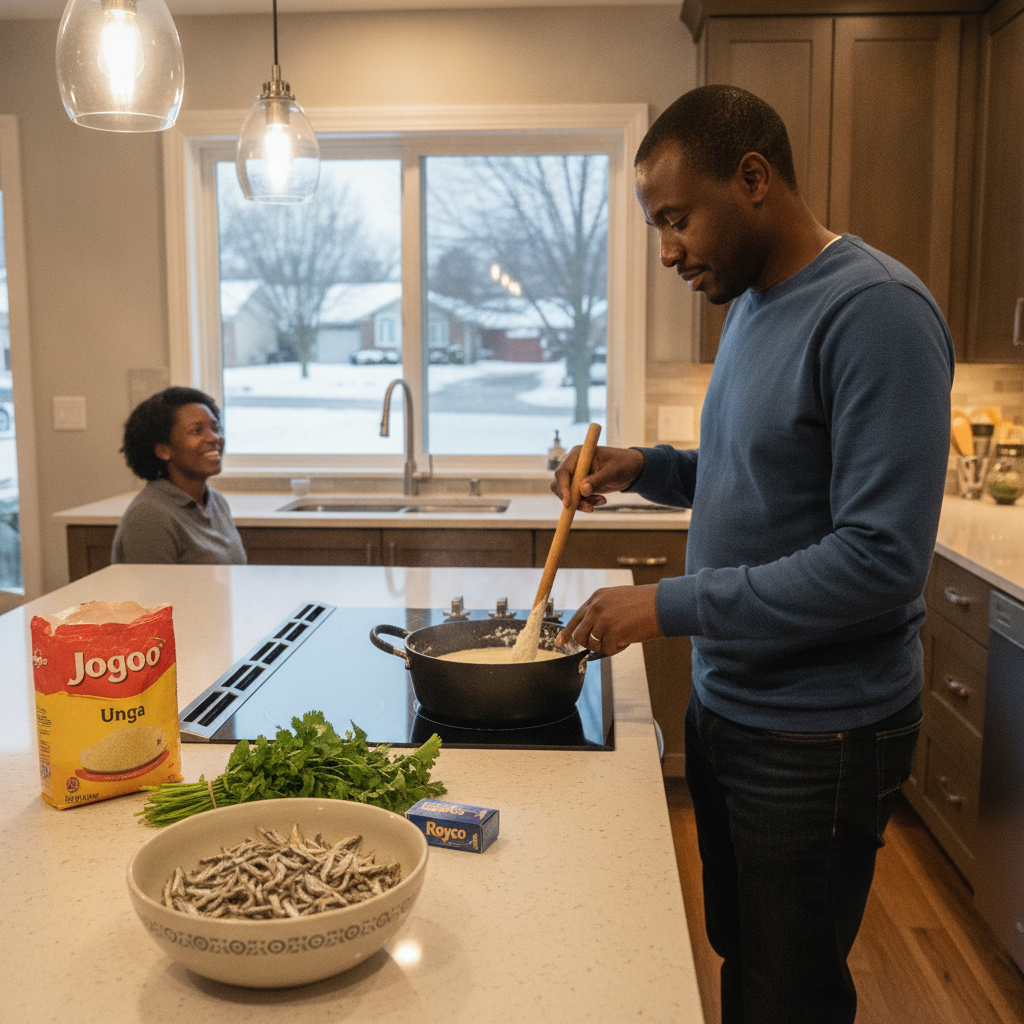
Kamau drove 45 minutes to the African grocery store on Lake Street. The trunk is full: two packets of Jogoo unga, a box of royco cubes, dried omena, a bag of wimbi flour, and a bunch of dhania that does not smell quite right but is the best he can find in Minnesota. He has been making this drive every two weeks since he moved here six years ago.
His wife is already rolling chapati when he walks in. The kitchen smells like home -- ghee and wheat flour and cardamom from the chai simmering on the stove. The children will eat the chapati with eggs. He and his wife will eat theirs with leftover beef stew. They cook ugali and sukuma wiki at least twice a week. On Sundays, his wife makes githeri. Food is not just nutrition in this house. It is the thread that connects his children to a country they visit once a year.
His mother back in Kenya was diagnosed with diabetes fourteen months ago. Kamau sends KES 15,000 every month for her medication. He called her last Sunday and she said she is fine, which is what she always says. He does not know what she ate for dinner. He does not know if her blood sugar is controlled. He cannot be there for her doctor's appointments. He sends money and feels helpless.
What Kamau does not know is that the cornmeal he drives 45 minutes to buy is not the same as Jogoo back home. Foreign cornmeal is not fortified. His ugali abroad has zero added iron, zinc, folate, or B12 -- nutrients that every bag of Kenyan maize flour has carried since 2012. He does not know that the collard greens in the grocery store two blocks from his house are nutritionally equivalent to sukuma wiki. He does not know that without the tomato-onion base his mother uses in every stew, his diaspora sukuma loses its vitamin C enhancer -- the compound that doubles iron absorption from the greens. He wants to eat Kenyan food and be healthy. He does not want to choose between them. But the version of Kenyan food he cooks in Minneapolis has invisible gaps that the same food back home does not.
“Food is a bridge that connects people to their culture, roots, and identity.”
Sound familiar?
You cook the food you grew up eating. You want your children to know it -- the taste of properly made ugali, the smell of chapati on Saturday morning, the way githeri tastes different from any bean dish in any American cookbook. You did not know the cornmeal you buy here is unfortified -- that the iron, zinc, and folate in every bag of Jogoo back home simply do not exist in the product on your shelf. You did not know that the collard greens two blocks away are nutritionally identical to sukuma wiki.
You are not doing anything wrong. You are missing one thing: a tool that knows your food -- including how it changes when you cook it abroad -- and shows you what your family actually absorbs from it.
Now score Saturday's chapati
Kamau logs Saturday dinner: ugali, sukuma wiki, omena. The score comes back: 48. The app flags something he never considered -- the cornmeal he buys is unfortified, unlike Jogoo back home. His ugali is missing iron, zinc, folate, and B12 that every Kenyan bag carries. It suggests two changes: add two boiled eggs to compensate for the absent fortification, and add raw kachumbari alongside the sukuma -- the vitamin C doubles iron absorption from the greens.
He tries it the next week. Same ugali. Same omena. Two eggs and a quick kachumbari from the tomatoes already in his fridge. He logs the meal. The score: 72. The food did not change much. The cost added two eggs. The completeness of what his family absorbed jumped by half.
He shares the app with his mother in Kenya. She logs her dinner -- the same ugali, sukuma wiki, beans -- but with Jogoo flour and the tomato-onion base she has always used. Her score is higher than his for the same dish. They finally have something specific to talk about on Sunday's call that is not "are you fine?" and "I am fine."