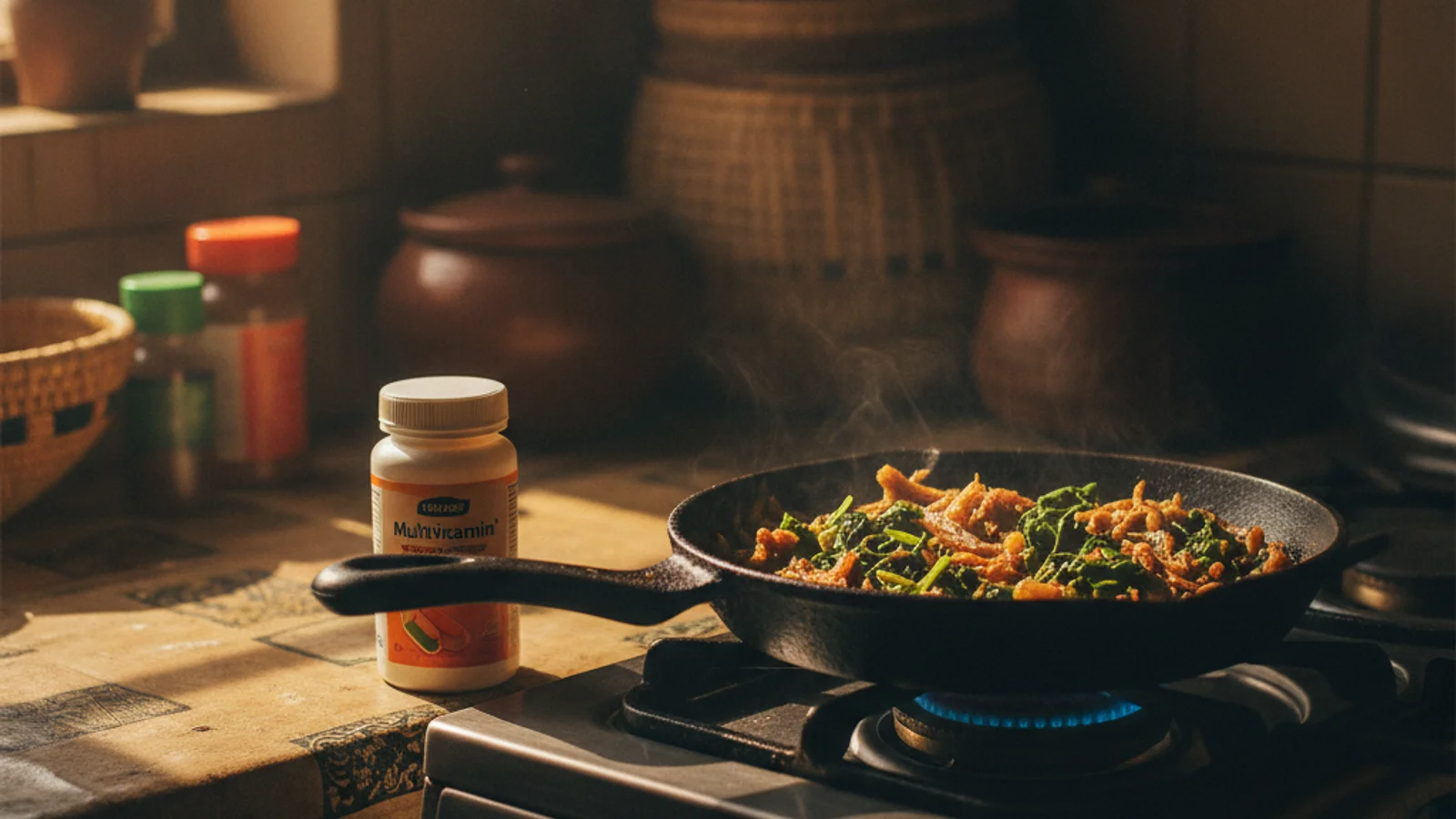
The budget meal that beats a supplement
A standard multivitamin promises a tidy list of nutrients in one tablet. A plate of Omena — Silver cyprinid (small dried fish) cooked with sukuma wiki, finished with lemon, costs less than that tablet and delivers more of what your body can actually use — for less than KES 100.
What's on the plate, and what it costs
- Omena (a generous handful, ~50g dried): roughly KES 50-60 at most markets. Rich in iron, calcium — including from the bones, since the whole fish is eaten — and omega-3 fatty acids.
- Sukuma wiki (one bunch): roughly KES 10-20. Vitamin A precursors, vitamin C, and highly bioavailable calcium (49% absorption, among the best of any leafy green — see our piece on sukuma wiki vs spinach).
- Half a lemon: roughly KES 5-10, often less if bought loose. Vitamin C, which multiplies the iron absorption from everything else on the plate.
- A spoon of cooking oil: negligible cost, already in most kitchens. Needed to absorb the fat-soluble vitamin A from the sukuma wiki.
Total: comfortably under KES 100, often closer to KES 70-80 depending on the market.
Try this tonight
Cook omena with sukuma wiki in a little oil. Squeeze half a lemon on top.
Nutrient-by-nutrient: food vs. supplement
Iron. A standard multivitamin carries around 8-18mg of iron, but it's almost always in a form — ferrous sulfate or similar — with no accompanying vitamin C, and it's frequently taken with tea or coffee, which blocks a large share of it before absorption. Omena carries meaningful heme and non-heme iron, and eating it with lemon on the same plate pushes absorption up 2 to 6 times versus the iron alone. Food-plus-context frequently outperforms tablet-alone here.
Calcium. Multivitamins typically carry only a token amount of calcium — often under 200mg — because calcium is bulky and a full dose won't fit in a small tablet. Omena, eaten with the bones as it traditionally is, plus sukuma wiki's 49% absorption rate, gives you a meaningful calcium contribution most multivitamins can't match at all.
Omega-3 fatty acids. This is where the supplement simply isn't in the conversation — most standard multivitamins carry none. Omena is a genuine source of omega-3s, the same category of fat prioritized in fish-oil capsules that cost far more than KES 100 on their own.
Vitamin A. Sukuma wiki supplies beta-carotene, a vitamin A precursor — but only if eaten with fat, which is exactly what the cooking oil in this dish provides. A multivitamin supplies pre-formed vitamin A directly, which is more reliably absorbed regardless of fat intake — this is one nutrient where the supplement has a real edge.
Vitamin C. Lemon delivers a solid dose of vitamin C directly and does double duty by boosting iron absorption from the rest of the plate — a multivitamin's vitamin C sits in the tablet doing nothing for the iron next to it, because they're not eaten together in a meal context.
Where supplements still make sense
This isn't an argument that supplements are useless — for a diagnosed deficiency, pregnancy-related iron and folic acid needs, or a genuinely restricted diet, a targeted supplement prescribed by a health provider does something food alone may not do fast enough. The claim here is narrower and better supported: for a healthy adult eating a normal diet, a well-prepared everyday meal often delivers more usable nutrition per shilling than a general multivitamin does, because food comes packaged with the co-factors — vitamin C, fat, gut-friendly ratios — that decide whether a nutrient gets absorbed at all.
The takeaway
Before you reach for a supplement bottle, check what's already possible on a KES 100 budget. Omena and sukuma wiki, cooked with a little oil and finished with lemon, deliver absorbable iron, calcium, omega-3s, and vitamins A and C in a single pan — and for several of those nutrients, they outperform what's sitting in a tablet on the shelf.
Sources
Get nutrition insights like this in your inbox